Saturday, 30 May 2009

Sotomayor

I've become mildly intrigued by Sotomayor's claim that "I would hope that a wise Latina woman with the richness of her experiences would more often than not reach a better conclusion than a white male who hasn't lived that life." I haven't been able to find the broader context (update, see this link) for that speech, but it suggests to me that she's invoking standpoint theory. As such, I resent Obama's attempt to brush this off with a "I'm sure she would have restated it" as if it were nothing more than a flippant remark rather than recognizing it as the rather important epistemological claim it may very well be.

It's also easy to understand why Obama's opponents would try to spin this into an accusation of racism, but that accusation is also to completely overlook, probably intentionally, what the claim is actually saying. If she's claiming that the experiences that a Latina woman has, presumably as an outsider of sorts, can in fact lend her insights and objectivity that many white males will lack, in virtue of their insider status, than that doesn't equate to racism, (although racism could well have contributed to the state of affairs giving Latina women outsider status). Her claim is a claim about the insight that experience lends, and neither implies nor follows from "a belief that race is the primary determinant of human traits and capacities and that racial differences produce an inherent superiority of a particular race" (the M-W definition of racism.)

I wish we could have a real conversation about Sotomayor's rather bold and noteworthy claim without dismissively sweeping it under the rug or going into politically motivated histrionics about racism.

Saturday, 23 May 2009

Dick is on the rise

Dick Cheney continues his somewhat remarkable process of agressively attacking Obama with his dueling banjo response to Obama's national security speech on Thursday. This leaves me a little perplexed because I've been largely disappointed in the extent to which Obama's national security policies, despite his lofty rhetoric, has mostly matched that of the Bush administration and at least some people on the right and on the left seem to share this view.

So, beyond symboic gestures, like closing Gitmo, Cheney's substantive policy criticisms of Obama seem to boil down to issues over torture, whether to do it or whether to release memos discussing it. (I won't bother to expressing my concerns about torture any further but it's worth noting that the war on terror advocates who've had the balls to try it out, Mancow and Hitchens, have both unequivocally ceded that it is torture and, essentially called 'bullshit' on Cheney's "advanced interrogation techniques" euphemism. Secondly, there is evidence that torture was used for establishing ties between al qaida and Iraq more than it was used to keep America safe are increasing.)

Cynically, I continue to wonder whether this is less about Cheney trying to keep America safe and more about the GOP having a strategy so that they'll be able to say "we told you so" should any future attacks occur.


Saturday, 16 May 2009

Wolfram Alpha

I played with Wolfram Alpha a bit this morning. So far it mostly seems like a nice web service front end on Mathematica, example link1 and link2, and a good source for straightforward kinds of information lookup, e.g., facts on a city, travel, (but it won't disambiguate 'seattle washington' as a potential query on travel b/w Seattle and D.C.) company information and the like.

It did rather poorly on the following:
To be fair, I've been evaluating it by posing questions in the same way that I'd posed them to Google. (with the exception of the mathematical queries). Unfortunately, I think that our experiences with Google shape our expectations and the way we test these new tools, we basically expect to be able to write natural language inputs. I think that if end users would be willing to open their minds a bit in terms of the way they submit input to a search/knowledge tool, the potential effectiveness would increase significantly and developers could spend more time on developing intelligent apps rather than solving the really really hard problem of understanding natural language input. I think about this frequently because the company I work for develop tools that are designed to exploit semantic search. We index documents using a knowledge base of concepts that gather synonyms and relations between those concepts. As a result we can understand, for example, that documents about aortic regurgitation are relevant to queries on 'heart valve disorder'. It's clear to me that our tools could be exploited so much more effectively if people would be able/ willing to use simple semantic relationships and variables in their queries. (Imagine being able to specify queries asking explicitly and fairly directly for, for example, articles about types of heart disease written by people affiliated with universities in the southwestern u.s. or the stock indices for stock markets located in Eastern Europe). But we're constrained, greatly IMO, by the fact that people expect / demand to use search engines only with natural language queries. It's like the rest of the world could be developing sophisticated robots capable of having sophisticated conversation in French, but we insist that we'll only use English when testing it.

UPDATE: BTW, should have mentioned, the 13 min. intro video is a good place to start (before experimenting) if you really want to have a sense of how to test it.

Wednesday, 13 May 2009

On Freedom and Quality of Life

Famously, something that often frustrates people in political discussions is the fact that political discussion tends to end up being much more like supporting one's favourite hockey team than a dispassionate inquiry into the best way for a government to operate, i.e., people care less about what their favoured party does than they care that it be successful and continue to hold power.

But less partisan political aficionados are often guilty of the sin of a priori politics. By this I mean the inclination to defend a political system or methodology without regard for its actual success or effectiveness in practice. In defending a political ideology I think we should be clear as to whether we're defending it because we view it as the best means to some other ends, in which case we need an account of what those ends are, or whether the fundamental principles are so important that we'd defend them regardless of their effectiveness in practice. So, for example, if I'm devoted to socialist libertarianism, what would it take to convince me that the system didn't work in practice? If we were to implement it and it resulted in a 80% drop in economic productivity and a 10 year decrease in lifespan would I continue to defend it because I think its basic principles are essential for a fair system, or would I acknowledge that part of the reason I embraced the system is because I thought it would result in greater equity with a relatively small drop in productivity and quality of life?

So, I think it's important to have a clear understanding of the political principles one holds but also the effect one thinks that such principles should allow us to achieve. What would have to be the case for us to give us those beliefs, that ideology? The point of all this is that I like looking for data that can be used to help evaluate such systems, while being painfully aware of the fact that political theory is particularly susceptible to the indeterminacy of theories problem.

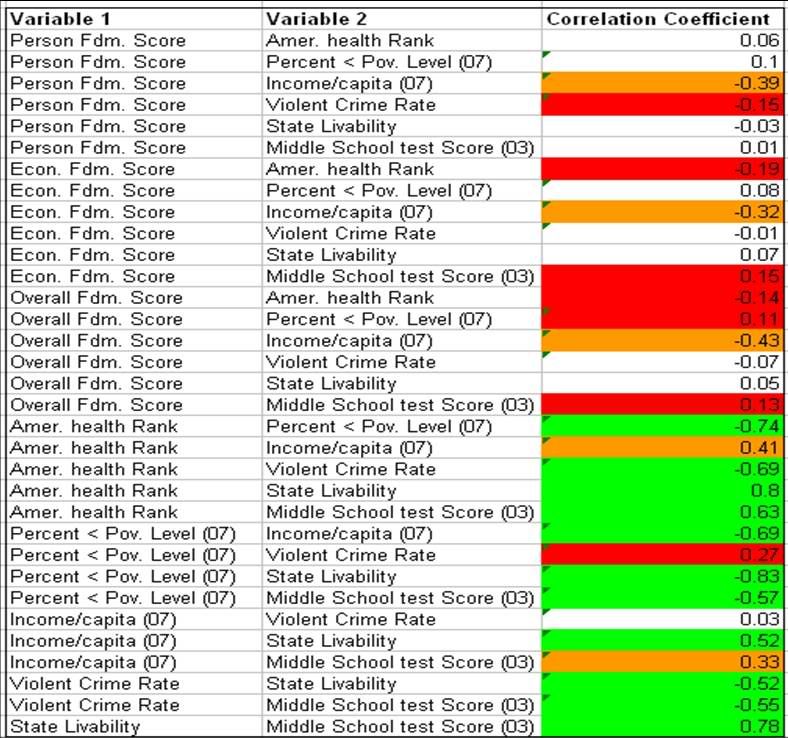
So, all that said, I was interested recently when someone posted a link to a paper, "Freedom in the 50 States", that attempted to quantify the level of freedom in each of the U.S. states. If we could really measure such a thing we could consider some other factors and see how or whether they benefit by increased or decreased government control so for starters I looked at correlations for some of these scores, while remaining agnostic about the quality of the metrics being used. (I also acknowledge that the level of variance between states for many of these variables is likely far smaller than it would be between countries, so if we're really interested in drawing conclusions it would be more useful to consider that.) In any event, here's what I came up with.


Observations:
There is a small --> medium negative correlation between increased freedom and average income levels.
I believe that crime rate is a factor in state livability so some of the correlation there is explained by that.
Not unexpectedly, there is a fairly large negative correlation between poverty levels and health level scoring.
There is no correlation between livability and the various freedom scores, nor between the violent crime rate and the freedom scores.
Other thoughts or observations?


Sources
Person Fdm. ScoreSource
Econ. Fdm. ScoreSource
Overall Fdm. ScoreSource
Amer. health RankSource
Percent < Pov. Level (07)Source
Income/capita (07)Source
Violent Crime RateSource
State LivabilitySource
Middle School test ScoreSource


Thursday, 30 April 2009

Miraculous, really?

"Head Coach Bruce Boudreau raises his fists in triumph as the Capitals complete a miraculous comeback from a 3-1 series deficit." (emphasis added)

I think the WaPo is setting the bar on miracles a bit low here. The Caps were ranked no. 2 in their conference, Rangers 7th. If two teams are equally matched, there's a 1 in 8 chance that the team behind 3-1 will come back to win, and here we can argue that they weren't equally matched, Caps were better. Historically, 9% of teams behind 3-1 have come back to win the series. So, I'd say this comeback is about as miraculous as seeing three red cards come up on the flop in a game of Texas Hold 'em or flipping heads three times in a row. But I guess "as the Capitals complete a mildly surprising comeback ..." isn't very compelling copy.


Saturday, 18 April 2009

The Torture Memos

I had mixed feelings this week when the Obama administration took the bold step of releasing the Bush administration secret torture memos. Link.

On the one hand, I think it's more or less clear that releasing the memos is a positive step toward openness and resolution. We can get some verification and clarification of what had long been rumored, we can get clear on the attempted justifications, etc. (Some are arguing that it was a bad idea to make these procedures public because they worked. I've written before (sept. '06, jan. '05) what I think about these arguments so I'll leave that alone now.)

But, while I'm pleased that the memos have been released I've become increasingly troubled by Obama's decision and commitment not to prosecute any of these people. Here's some of what Obama said to explain why he didn't want to pursue prosecution of those who participated.

But at a time of great challenges and disturbing disunity, nothing will be gained by spending our time and energy laying blame for the past. Our national greatness is embedded in America’s ability to right its course in concert with our core values, and to move forward with confidence. That is why we must resist the forces that divide us, and instead come together on behalf of our common future.

There are a number of things I find objectionable here. (And, I refer interested readers to Keith Olbermann's commentary and a post by Chris Floyd that probably do a nicer job of articulating some of these concerns.) Let me try to spell out in three interrelated points.

1) The principle that "nothing will be gained by spending our time and energy laying blame for the past" seems to undermine a cornerstone of our system of justice, i.e., that crime cannot go unpunished. As Floyd notes "And cannot every criminal on the face of the earth now claim the Obama defense: 'Surely, your honor, nothing will be gained by spending our time and energy laying blame for the past. So let's forget the fact that I (raped/murdered/robbed/tortured), and move forward, shall we?' "

2) Anyone suspicious that the rules in the U.S. are only for the "little people"; that big finance and big auto and big brother can get away with flouting the rules, now has more basis for their concerns. If we contend that our government is above the law, that their illegal activity won't be prosecuted for whatever reasons, don't we undermine respect for the rule of law? Juxtapose this with recent data about the high incarceration rates in this country, particularly amongst African Americans and it suddenly becomes very difficult to argue that we don't have two sets of rules in this country.

3) Finally I'd like to further consider a point that Olbermann and Floyd have made, i.e., the concern that this response appears to appeal to the Nuremberg defense, i.e., the assumption that flouting the law is permissible when one is "simply following orders". It's useful to consider the reasons that we've rejected this defense. The Nuremberg defense suggests a very disturbing position on the role of law and the obligations of citizens. Laws, in this view, seem to be nothing more than manifestations of what the powerful want us to do. If, as I'd argue, laws implement and instantiate abstract principles of just practice, principles that we're all, qua humans and citizens, obligated to follow, then no dispensation from the powerful can override them. The Nuremberg defense is legitimate only if we assume that we're in a system in which laws are nothing more than rules and constraints put forward by 'the man", obligations created by and therefore retractable by those in power. If that's what we believe, then it's reasonable to allow that the government is allowed to make exceptions whenever it sees fit and the Nuremberg defense is a legitimate one. In the Nuremberg defense scenario, citizens are guilty if and only if they fail to do what the government tells them to do, there is no law beyond a base will to power. But we reject Nuremberg defenses if we hold that all people are citizens and all are obligated to follow the general principles of justice, rather than the pragmatic procedures decided on in secret by a small group of powerful men.


Monday, 13 April 2009

I'm sure I've ranted about this before, but I think hockey badly needs a "sabermetrification", i.e, a move to refine and take their stats more seriously. Here's an example from something I've been seeing lately. There's some talk that the Washington Capitals have set records for most points, most wins and most home wins in a season. But the problem is that the original records were set by the 1985-86 Capitals team. That team played at a time at which there was no shootout or regular season overtime, games tied at the end of regulation just ended with each team gaining a point. Also, that team played only 80 games, not 82 as they play today. Today, games ending in ties in regulation are 3 point games, a consolation point going to the loser, that wasn't the case in 85-86. So the teams now have more opportunities for wins and there are more points that can be won in a game. It's silly to just compare their records straight up. It's like comparing prices without adjusting for inflation.

It wouldn't be that hard to get a fair comparison, we'd just need to normalize the points. The most accurate way to normalize is to subtract all pts. gained in OT or SO (win or loss) and then give the Caps exactly one pt. for each game that ended in a tie in regulation. I don't have those numbers handy, an approximation is to drop the pts. gained in OT losses. So, this year's Caps have 96 "normalized" pts. after dropping the 8 pts they gained in OT losses. To finish with a comparable record they'd have to get 110 "normalized" pts. (they have 2 extra games, take the percentage of possible pts. the 85-86 team, won, .66875, and multiply by 82). But this year's team has only 3 games left. Or we could normalize the 85-86 records, perhaps most simply by assuming they'd have received a win in half their ties had they gone to a tiebreaker. This would give the 85-86 team 111 points in 80 games, which pro-rates to 114 in 82. So, IMO, the old record is safe.

What was Boudreau's, Caps coach, response when asked if these format changes rendered the record less impressive? "
You're going to have detractors anywhere you go when it comes to records. Everyone is going to want to put asterisks and things beside people's names. But in today's era, everything has changed. Everything has gotten bigger, faster, stronger, quicker. There was no salary cap in the '80s, either. There could have been a huge discrepancy. Everything evens out in the long run."

Hmm, I have no idea why the speed or strength of today's player is relevant. That today's players are faster and stronger doesn't change the fact that they give out more points and chances for wins today.