Thursday, 16 July 2009

Democrats' House Healthcare Bill

I haven't read the Dem's house bill on healthcare or even read much commentary, but with that caveat I will say that I'm pretty sure that imposing heavier burdens on businesses in terms of providing health care insurance, as this bill is apparently doing, really can't be the way to go. Health care costs are already severely undermining the ability of US companies to compete in the global marketplace. Compromise is often a laudable thing, but in the case of the US healthcare system, I think it's so badly broken that we really need to start over from scratch. My solution, of course, would be to implement a universal single payer system, I think the data shows that this is very efficient and effective. To see how this translates into global competitiveness one need only research the competitive advantage that Canadian car plants are afforded, as compared to their US counterparts, by the fact that they don't have to buy healthcare for each worker. But, even if my solution isn't the solution ultimately implemented, I'd argue that going further down the road of employer provided healthcare deepens the long term problem.

(And I apologize for sounding like a pro-business blowhard. I'm not a huge fan of globalization and in general, arguments about cutting benefits because the global marketplace demands it are unconvincing to me. But in this case I think the global marketplace is effectively underscoring a huge inefficiency in the US marketplace, an inefficiency that we ignore at our peril.)


Tuesday, 7 July 2009

Challenge problems

Apparently a team has reached the threshold in the Netflix contest to improve quality of viewer suggestions by 10% (for a $1 million prize!):


http://www.netflixprize.com//leaderboard

A blog on the process here:

http://bits.blogs.nytimes.com/2009/06/26/and-the-winner-of-the-1-million-netflix-prize-probably-is/

(and, somewhat tangentially, a nice "SVD/LSI [a method often used for recommendation systems] for dummies" article here: http://www.igvita.com/2007/01/15/svd-recommendation-system-in-ruby/ (including an implementation in Ruby as the URL suggests) )

This "bounty" system of development seems to be proving very effective and relatively inexpensive. See also the DARPA Grand Challenge effort that managed to produce an effective driverless vehicle system for a tiny, tiny fraction of what a full blown traditional DARPA program would have cost, assuming a traditional program would have managed to do it at all. My claim: This provides evidence that in a post-industrial society, and maybe in all, a gift economy is superior to a market economy for purposes of providing innovation, people valuing prestige and satisfaction of solving challenges even more highly than material gain. (While the prizes here are, prima facie, substantial, the actual reward to participants is likely far, far less than they'd have received in typical market production scenarios even if they were just being paid for their time. If one considers, for example, what a DARPA program would have paid for the person hours that the winning team alone would have cost in the Grand Challenge, I imagine it would have far exceeded the prize money actually paid out.)


Sunday, 14 June 2009

Deficit Fears

Robert Reich wonders why the great debt scare has returned and hints that conservative deficit hawks in Obama's inner circle are to blame:

Is it possible that among the President’s top economic advisors and top ranking members the Fed are people who agree more with conservative Republicans and Wall Streeters on this issue than with the President? Is it conceivable that they are quietly encouraging the Debt Scare even in traditionally liberal precincts, in order to reduce support in the Democratic base for what Obama wants to accomplish? Hmmm.

I wonder if Reich has let ideology get ahead of him. I'm no deficit hawk, and I embrace the fundamental tenets of Keynesian economics, and have no knee jerk opposition to government spending as necessarily inefficient. However, I think there are real reasons to worry about the deficit here, reasons that have nothing to do with Conservative conspiracies. As a matter of fact, there is a real issue over how this debt is going to be financed. The markets recently showed an unwillingness to keep on buying T-bills forever, the yield on the 10 year t-note took a big jump as inflation worries mounted, for good reason. In addition to a mounting deficit, significant questions over the solvency of Medicaid and Social Security remain. It's not so much that deficit spending is inherently bad, but it becomes bad and worrisome when we don't know how much that deficit spending is going to cost us and when our ability to repay the accumulating debt becomes increasingly unclear.

All this said, attempts by Republicans to make political hay out of this by painting the Obama administration as irresponsible profligate spenders, when their fiscal policies (and lack thereof), contributed so heavily to the current debt and economic situation is some of the astounding cynical political maneuvering I've ever witnessed.

Saturday, 30 May 2009

Sotomayor

I've become mildly intrigued by Sotomayor's claim that "I would hope that a wise Latina woman with the richness of her experiences would more often than not reach a better conclusion than a white male who hasn't lived that life." I haven't been able to find the broader context (update, see this link) for that speech, but it suggests to me that she's invoking standpoint theory. As such, I resent Obama's attempt to brush this off with a "I'm sure she would have restated it" as if it were nothing more than a flippant remark rather than recognizing it as the rather important epistemological claim it may very well be.

It's also easy to understand why Obama's opponents would try to spin this into an accusation of racism, but that accusation is also to completely overlook, probably intentionally, what the claim is actually saying. If she's claiming that the experiences that a Latina woman has, presumably as an outsider of sorts, can in fact lend her insights and objectivity that many white males will lack, in virtue of their insider status, than that doesn't equate to racism, (although racism could well have contributed to the state of affairs giving Latina women outsider status). Her claim is a claim about the insight that experience lends, and neither implies nor follows from "a belief that race is the primary determinant of human traits and capacities and that racial differences produce an inherent superiority of a particular race" (the M-W definition of racism.)

I wish we could have a real conversation about Sotomayor's rather bold and noteworthy claim without dismissively sweeping it under the rug or going into politically motivated histrionics about racism.

Saturday, 23 May 2009

Dick is on the rise

Dick Cheney continues his somewhat remarkable process of agressively attacking Obama with his dueling banjo response to Obama's national security speech on Thursday. This leaves me a little perplexed because I've been largely disappointed in the extent to which Obama's national security policies, despite his lofty rhetoric, has mostly matched that of the Bush administration and at least some people on the right and on the left seem to share this view.

So, beyond symboic gestures, like closing Gitmo, Cheney's substantive policy criticisms of Obama seem to boil down to issues over torture, whether to do it or whether to release memos discussing it. (I won't bother to expressing my concerns about torture any further but it's worth noting that the war on terror advocates who've had the balls to try it out, Mancow and Hitchens, have both unequivocally ceded that it is torture and, essentially called 'bullshit' on Cheney's "advanced interrogation techniques" euphemism. Secondly, there is evidence that torture was used for establishing ties between al qaida and Iraq more than it was used to keep America safe are increasing.)

Cynically, I continue to wonder whether this is less about Cheney trying to keep America safe and more about the GOP having a strategy so that they'll be able to say "we told you so" should any future attacks occur.


Saturday, 16 May 2009

Wolfram Alpha

I played with Wolfram Alpha a bit this morning. So far it mostly seems like a nice web service front end on Mathematica, example link1 and link2, and a good source for straightforward kinds of information lookup, e.g., facts on a city, travel, (but it won't disambiguate 'seattle washington' as a potential query on travel b/w Seattle and D.C.) company information and the like.

It did rather poorly on the following:
To be fair, I've been evaluating it by posing questions in the same way that I'd posed them to Google. (with the exception of the mathematical queries). Unfortunately, I think that our experiences with Google shape our expectations and the way we test these new tools, we basically expect to be able to write natural language inputs. I think that if end users would be willing to open their minds a bit in terms of the way they submit input to a search/knowledge tool, the potential effectiveness would increase significantly and developers could spend more time on developing intelligent apps rather than solving the really really hard problem of understanding natural language input. I think about this frequently because the company I work for develop tools that are designed to exploit semantic search. We index documents using a knowledge base of concepts that gather synonyms and relations between those concepts. As a result we can understand, for example, that documents about aortic regurgitation are relevant to queries on 'heart valve disorder'. It's clear to me that our tools could be exploited so much more effectively if people would be able/ willing to use simple semantic relationships and variables in their queries. (Imagine being able to specify queries asking explicitly and fairly directly for, for example, articles about types of heart disease written by people affiliated with universities in the southwestern u.s. or the stock indices for stock markets located in Eastern Europe). But we're constrained, greatly IMO, by the fact that people expect / demand to use search engines only with natural language queries. It's like the rest of the world could be developing sophisticated robots capable of having sophisticated conversation in French, but we insist that we'll only use English when testing it.

UPDATE: BTW, should have mentioned, the 13 min. intro video is a good place to start (before experimenting) if you really want to have a sense of how to test it.

Wednesday, 13 May 2009

On Freedom and Quality of Life

Famously, something that often frustrates people in political discussions is the fact that political discussion tends to end up being much more like supporting one's favourite hockey team than a dispassionate inquiry into the best way for a government to operate, i.e., people care less about what their favoured party does than they care that it be successful and continue to hold power.

But less partisan political aficionados are often guilty of the sin of a priori politics. By this I mean the inclination to defend a political system or methodology without regard for its actual success or effectiveness in practice. In defending a political ideology I think we should be clear as to whether we're defending it because we view it as the best means to some other ends, in which case we need an account of what those ends are, or whether the fundamental principles are so important that we'd defend them regardless of their effectiveness in practice. So, for example, if I'm devoted to socialist libertarianism, what would it take to convince me that the system didn't work in practice? If we were to implement it and it resulted in a 80% drop in economic productivity and a 10 year decrease in lifespan would I continue to defend it because I think its basic principles are essential for a fair system, or would I acknowledge that part of the reason I embraced the system is because I thought it would result in greater equity with a relatively small drop in productivity and quality of life?

So, I think it's important to have a clear understanding of the political principles one holds but also the effect one thinks that such principles should allow us to achieve. What would have to be the case for us to give us those beliefs, that ideology? The point of all this is that I like looking for data that can be used to help evaluate such systems, while being painfully aware of the fact that political theory is particularly susceptible to the indeterminacy of theories problem.

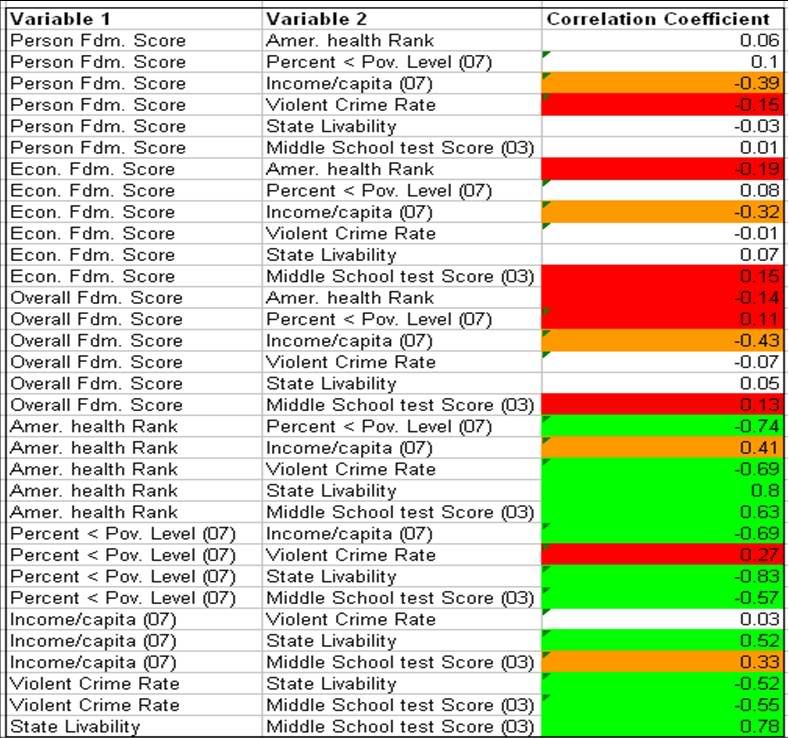
So, all that said, I was interested recently when someone posted a link to a paper, "Freedom in the 50 States", that attempted to quantify the level of freedom in each of the U.S. states. If we could really measure such a thing we could consider some other factors and see how or whether they benefit by increased or decreased government control so for starters I looked at correlations for some of these scores, while remaining agnostic about the quality of the metrics being used. (I also acknowledge that the level of variance between states for many of these variables is likely far smaller than it would be between countries, so if we're really interested in drawing conclusions it would be more useful to consider that.) In any event, here's what I came up with.


Observations:
There is a small --> medium negative correlation between increased freedom and average income levels.
I believe that crime rate is a factor in state livability so some of the correlation there is explained by that.
Not unexpectedly, there is a fairly large negative correlation between poverty levels and health level scoring.
There is no correlation between livability and the various freedom scores, nor between the violent crime rate and the freedom scores.
Other thoughts or observations?


Sources
Person Fdm. ScoreSource
Econ. Fdm. ScoreSource
Overall Fdm. ScoreSource
Amer. health RankSource
Percent < Pov. Level (07)Source
Income/capita (07)Source
Violent Crime RateSource
State LivabilitySource
Middle School test ScoreSource